
If you manage a commercial property in Manhattan or the outer boroughs, you probably know this. Keeping it in good shape takes constant work. New York City grime makes it harder. Recently, many operations directors have looked to leading institutional models to solve the problem of declining cleaning quality. Establishing clear NYC facility management standards is the first step toward reclaiming control of your building’s environment.
Michelangelo spent four years on his back painting the Sistine Chapel ceiling. He also left detailed notes on why small details matter. He summed up the case for high standards in one line:
“Trifles make perfection, and perfection is no trifle.” – Michelangelo
That’s the operating principle of institutional-grade facility management. Nothing in this article is exotic. It’s a hundred small standards, applied every night, that add up to a building tenants trust. It’s also why serious operators track cleaning industry news. APPA guideline updates, chemical safety revisions, and equipment innovations often change what “standard” means each year.
Documented cleaning frequencies are essential for compliance and long-term asset protection. Institutional models use specific schedules for tiled and linoleum surfaces to meet APPA standards. Without a clear plan, technical tasks like burnishing or deep scrubbing are often skipped. This leads to premature floor failure and increased replacement costs.
Colin Powell ran one of the world’s largest organizations. He made the case for written standards in a clear, blunt way:
“There are no secrets to success. It is the result of preparation, hard work, and learning from failure.” — Colin Powell
A documented cleaning frequency is preparation. Skipping it because “we know the drill” is where facility programs quietly fail. This often happens right before a floor needs $80,000 in replacement work. A proper VCT program would have prevented that. The right industrial cleaner, used on the wrong schedule, can still cause finish failure. Documented schedules keep the chemistry and timing aligned.
We recommend a structured VCT maintenance program. It sets clear times for each surface. The schedule depends on foot traffic and soil levels.
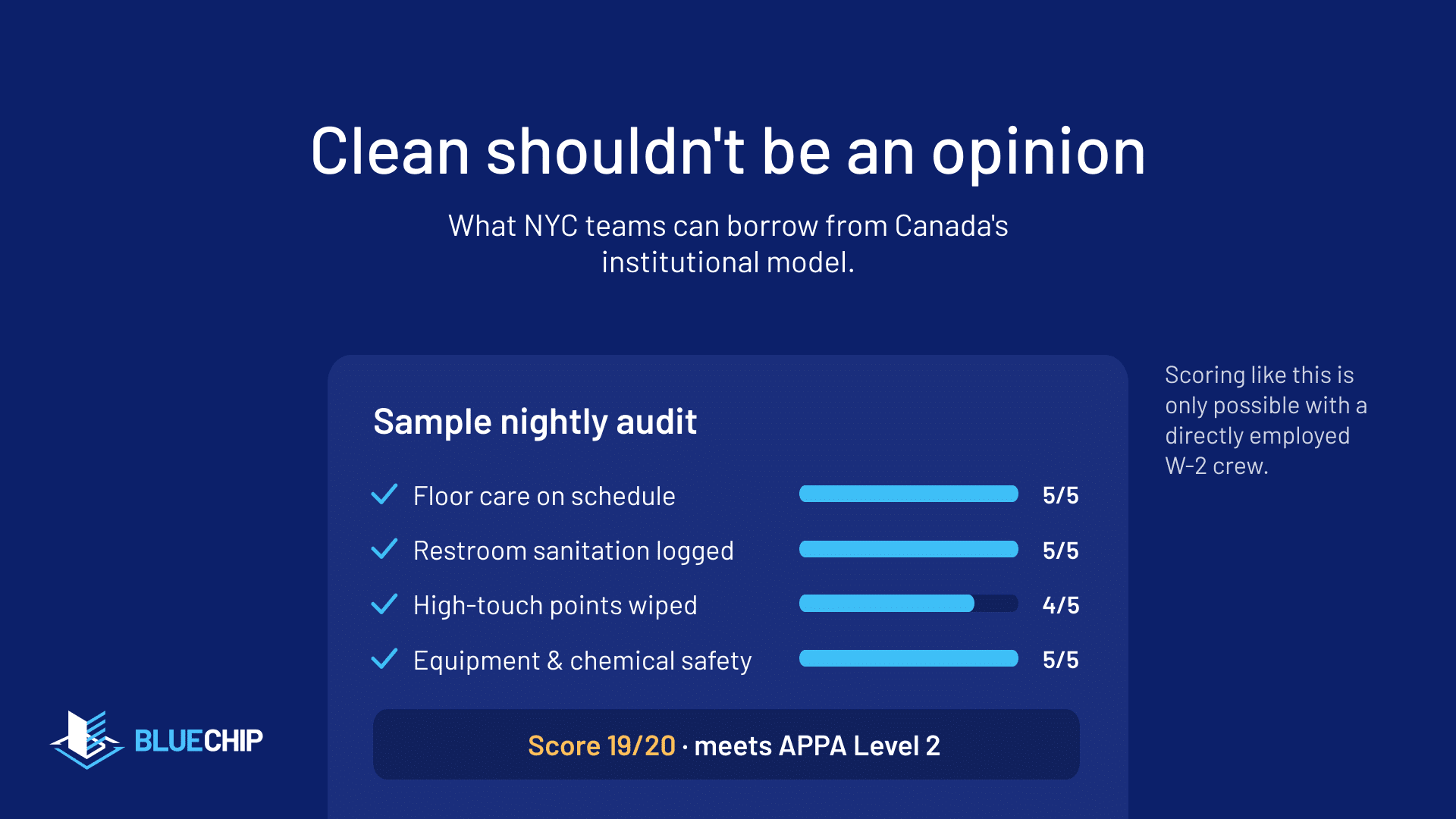
Standardized scoring systems eliminate subjective quality assessments. When a facility manager and a cleaning vendor disagree on what “clean” means, the building suffers. By using an objective auditing system, you can audit caretaking staff performance using data instead of opinion. This level of oversight is only possible when you use a self-performed W-2 workforce. Unlike subcontracted crews, directly employed teams follow specific technical protocols exactly. This accountability ensures that APPA cleaning standards are met every night, not just when an inspection is looming.
Lord William Thomson Kelvin was a physicist. His name later became a temperature scale. He established a key principle for every serious auditing program:
“When you can measure what you are speaking about, and express it in numbers, you know something about it; but when you cannot express it in numbers, your knowledge is meager.” – Lord Kelvin
Blue Chip Building Maintenance has provided expert facility care for over 25 years in the NYC metro area. We know that adopting institutional-grade standards protects your building’s bottom line. It extends the life of your finishes and improves tenant satisfaction. To ensure your facility remains in peak condition, contact Blue Chip Building Maintenance today to schedule a walk-through.
© 2026 Blue Chip Building Maintenance | Privacy
This site is protected by reCAPTCHA and the Google Privacy Policy and Terms of Service apply.