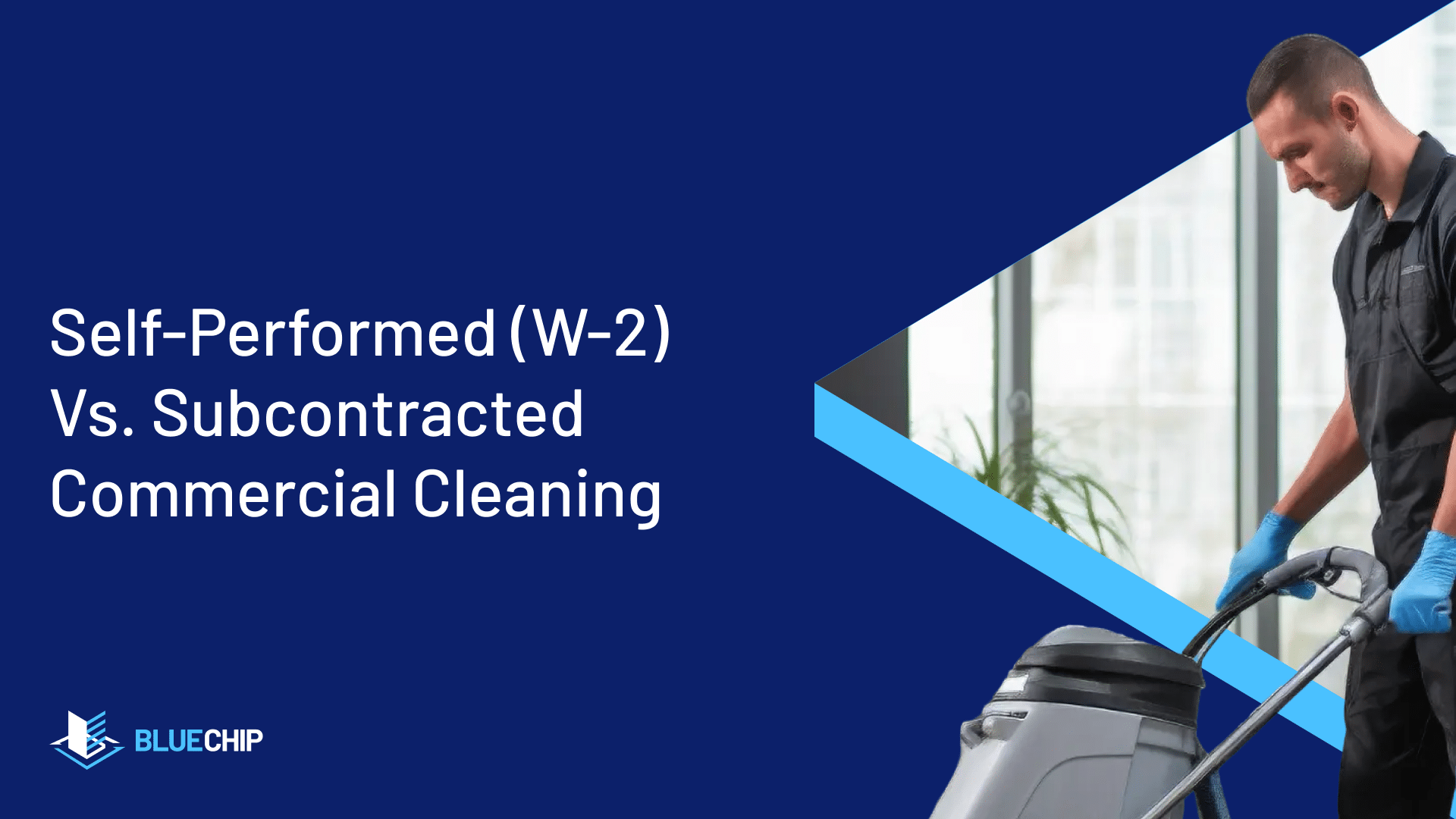
The short version: A self-performed cleaning company puts its own W-2 employees in your building. A subcontracted company wins your contract and then hires other firms (or 1099 crews) to do the actual work. The difference rarely shows up in the proposal. It shows up in who is accountable when a shift is missed. It also shows up when a crew rotates without notice. It shows up when a compliance question lands on your desk. For facility managers, the labor model is a strong but often overlooked sign. It shows if a vendor will stay reliable into year three.
Self-performed cleaning means the company you hire is the company that does the work. The cleaners are its own W-2 employees – background-checked, trained, supervised, and paid by the firm whose name is on your contract. There is no second layer between you and the people mopping your floors. That single fact is the basis of accountability. When you call about a problem, you reach the people who can fix it. They employ the crew.
This is the model Blue Chip is built on – a fully employee-based workforce with no subcontracting, which is the core of our difference as an operator and what lets us stand behind documented quality standards across commercial janitorial, floor care, and specialized work.
In a subcontracted model, the company that signs your contract doesn’t perform the work. It brokers it — handing the actual cleaning to a separate firm, a staffing agency, or 1099 contractors. You’re paying a vendor to manage other people’s labor. Sometimes that’s transparent. Often it is not, and facility managers do not learn this until a problem keeps coming back. It does not get fixed because they are not talking to the right people.
Subcontracting isn’t automatically bad. It can cut headline costs, add surge capacity for one-off jobs, or extend a vendor into areas they don’t staff. The problem is that a janitorial partner should deliver consistency, accountability, and a clear compliance record. Subcontracting chains often weaken those exact benefits.
| What you care about | Self-performed (W-2) | Subcontracted |
|---|---|---|
| Accountability | One company owns the result | Diffused across a chain; finger-pointing when issues arise |
| Crew consistency | Same vetted team, lower turnover | Crews can rotate without notice |
| Training & standards | Controlled and documented in-house | Varies by whoever was hired this week |
| Background checks / vetting | Direct and verifiable | Often unverifiable down the chain |
| Liability exposure | Clear employer of record | Co-employment and misclassification risk |
| Responsiveness | Direct line to supervision | Messages relayed through a middleman |
| Cost | Transparent, sometimes higher | Lower on paper; hidden costs over time |
Accountability gaps. When the crew doesn’t work for the company you contracted, “we’ll look into it” becomes the default answer. Fixes are slower because the firm you’re paying has to manage a third party to get anything done.
Crew inconsistency. Subcontracted and 1099 labor turns over faster. New faces every few weeks means re-learning your building, your security protocols, and your standards – over and over.
Liability and worker classification. This is the risk most facility managers underestimate. When labor is layered through subcontractors and independent contractors, classification gets murky, and misclassification carries real legal and financial exposure. The IRS draws a clear line between an employee and an independent contractor. The U.S. Department of Labor treats worker misclassification as a serious violation. Co-employment claims can reach the client, not just the vendor. A direct W-2 model keeps the employer of record unambiguous.
Vetting you can’t verify. Background checks are only as good as the layer that performed them. In a subcontractor chain, you often can’t confirm who vetted the person with after-hours access to your building.
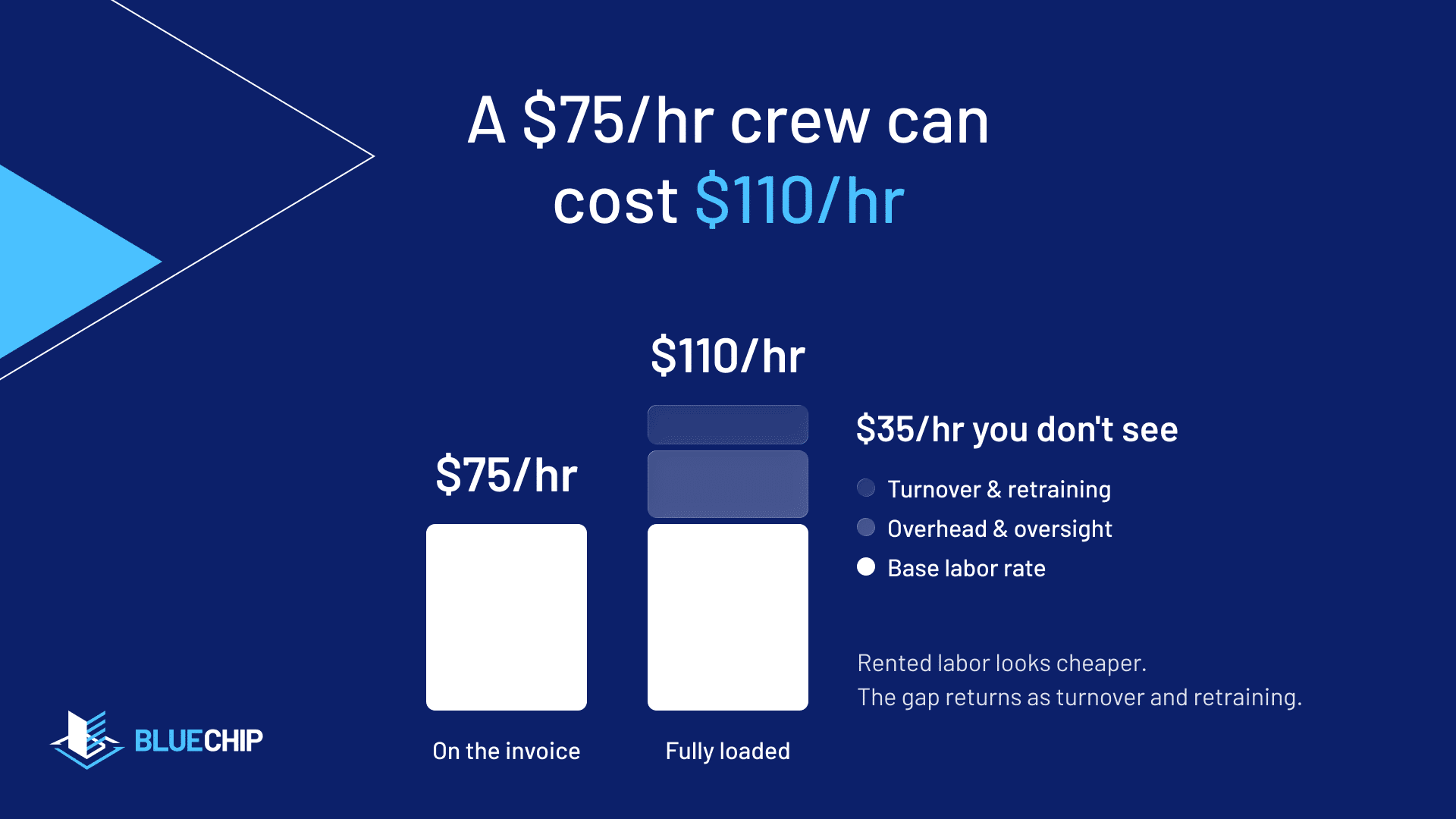
Choosing between an employed crew and subcontracted labor is a common operations decision. Do you build the capability in-house, or rent it from a third party? The tradeoffs rhyme across departments. Marketing leaders weigh it when they compare a fractional CMO, an agency, and an in-house hire. Software teams weigh it when they choose between in-house and outsourced quality assurance. Finance teams see it fast. A contractor’s rate can hide the fully-loaded cost of contract labor. A $75/hour contractor can cost $110 after overhead. Even staffing models built deliberately around contractors, like marketplaces of pre-vetted specialist talent, work precisely because they solve the vetting-and-accountability problem that ad-hoc subcontracting creates.
The lesson for facility managers stays the same: rented labor may look cheaper on the invoice. But the party that controls the workforce also controls accountability. In a building you’re responsible for, that control is the whole point.
You do not need an audit to learn how a vendor staffs. Ask a few direct questions. Then read the proposal with care. (A lower bid often means less work is included. It may also mean a subcontracted crew. It is not always a better deal. It helps to read a cleaning quote line by line. It also helps to know about what commercial cleaning costs in NYC before you compare prices.)
Questions to ask before you sign:
If the answers include another company’s name, you are using a subcontracted model. You should price the accountability tradeoff accordingly.
The labor model matters most where the work is technical. Floor care is a clear example. A proper strip-and-wax and VCT finish program needs trained technicians. They must know dwell times, finish solids, and burnishing. It should not rely on a rotating crew learning on your floors. (If you’re new to it, our waxing 101 primer covers the basics.) The same logic applies to disinfection in medical and clinical spaces. In these settings, consistency and documentation are required.
Subcontracting can make sense for a one-time job or a market a vendor doesn’t staff directly. For the ongoing upkeep of a building you manage, a self-run W-2 workforce helps ensure consistent work. It also improves accountability and supports your compliance records. Ask the questions, read the scope, and know which one you’re buying.
Ready to compare? Request a free estimate from Blue Chip. We’ll walk your facility and document the scope. We’ll also show you who will clean your building. They work for us.
Related: commercial janitorial services; cleaning quality KPIs, inspections and SLAs; how to write a janitorial RFP.
95 %
© 2026 Blue Chip Building Maintenance | Privacy
This site is protected by reCAPTCHA and the Google Privacy Policy and Terms of Service apply.