
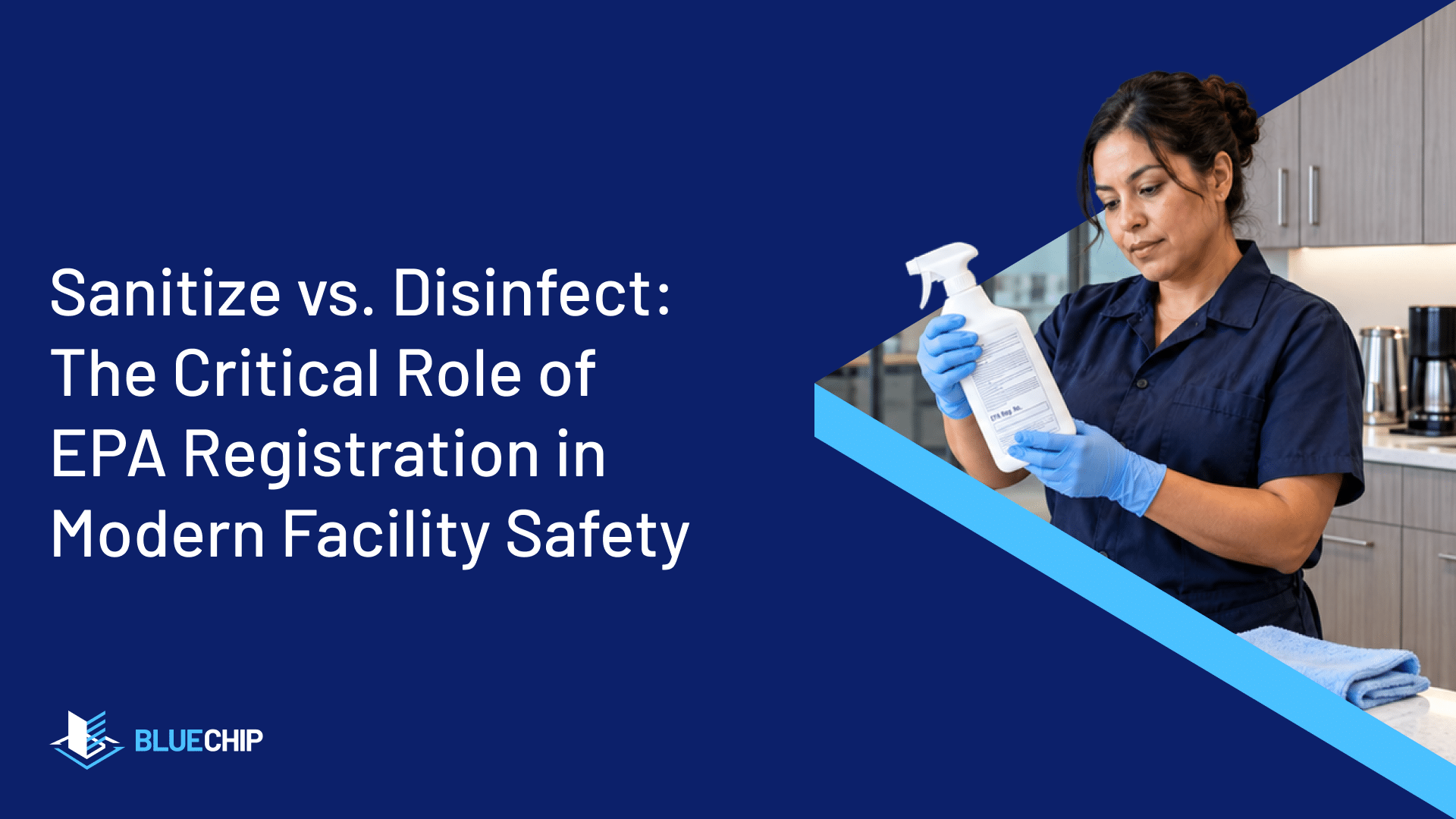
In a high-density NYC office, looking clean and being safe are two different things. Safety depends on EPA registration numbers and stopwatch-timed dwell periods. Many facility managers treat all cleaning chemicals as equal. In reality, a product that removes visible soil may do nothing to stop viral pathogens. In our experience at Blue Chip Building Maintenance, compliance is the only reliable way to protect tenants. This requires moving beyond simple janitorial duties. You must have a technical understanding of different cleaning agents.
The EPA regulates products used to kill viruses and bacteria on surfaces as antimicrobial pesticides. There is a rigid legal and technical distinction between these categories. Cleaning is merely the physical removal of dirt and organic matter using detergents. While it is a necessary first step, it does not kill microorganisms. Sanitizing goes further by reducing bacteria to safe levels. However, it is not intended for viral elimination. For high-traffic environments, understanding the technical distinctions between cleaning and disinfecting is essential for health compliance.
Sanitizers are tested and registered to kill 99.9% of specific bacteria on non-porous surfaces. However, they are not formulated or legally permitted to claim efficacy against viruses like Influenza or SARS-CoV-2. If your vendor only sanitizes high-touch surfaces during flu season, they leave a gap in your facility’s defenses. To achieve viral inactivation, you must use a registered disinfectant. These products undergo more rigorous testing to prove they can irreversibly inactivate both bacteria and viruses.
Every professional-grade disinfectant must carry a unique EPA Registration Number on its label. This number is the only way to accurately identify a product and verify its kill claims. Products without this registration are legally classified only as cleaners. We have found that relying on non-compliant solutions increases corporate liability for NYC tenants. This is especially true in shared spaces where viral loads can accumulate quickly. Verification of these numbers ensures that the chemicals meet federal standards for the specific pathogens you are targeting.
| Category | Primary Function | Pathogen Efficacy | Regulatory Requirement |
|---|---|---|---|
| Cleaning | Physical removal of dirt and organic matter | Does not kill microorganisms | Not classified as antimicrobial |
| Sanitizing | Reducing bacteria to safe levels | Kills 99.9% of specific bacteria;not for viruses | EPA registered for bacteria |
| Disinfecting | Irreversible inactivation of pathogens | Kills bacteria and viruses (e.g., Influenza, SARS-CoV-2) | Unique EPA Registration Number |
Electrostatic disinfection services involve applying a specialized coating to surfaces using an electrode to charge the disinfectant droplets. This charge creates an electromagnetic attraction between the liquid and the surface. This ensures the chemical wraps around furniture, fixtures, and hard-to-reach areas.
Unlike traditional fogging, electrostatic spraying makes a targeted mist that sticks to surfaces instead of hanging in the air. This precision is critical for medical office cleaning. It allows us to treat sensitive electronics and medical equipment without over-saturation. By using this technology, we can achieve high-level disinfection across large areas quickly. It is much faster than manual methods while maintaining a higher degree of biological safety.
The most overlooked factor in facility maintenance is dwell time, also known as contact time. This is the duration a surface must remain visibly wet with a disinfectant to achieve its stated 99.999% germ kill rate. Most commercial disinfectants require a dwell time of three to ten minutes. If a cleaner sprays a surface and immediately wipes it dry, the chemical reaction is interrupted. The pathogens likely survive. In our technical protocols, we emphasize that speed is the enemy of safety. A W-2 workforce trained in these specific dwell times is the only way to ensure the chemical works correctly.
In high-density urban environments, the stakes for proper disinfection are elevated. Using non-compliant solutions or ignoring dwell time mandates increases the risk of workplace outbreaks. It also increases corporate liability. Proper surface management is an engineering control that directly affects the air quality occupants breathe. It prevents pollutants from becoming airborne. Professional facility safety is not just about looks. It is a mandatory benchmark for health compliance.
“The clean person is not the one who has washed, but the one who has not become dirty.” : Epictetus
To ensure your facility is meeting medical-grade standards, perform these four specific audits on your current cleaning program:
Blue Chip Building Maintenance has provided technical cleaning and facility services since 1991. We operate with a dedicated W-2 workforce to ensure that every disinfection protocol is executed with precision. Verified EPA registration and proper dwell times are the foundation of our process. This protects your tenants and your physical assets. Schedule a walk-through today. See how our medical cleaning services and medical-grade standards can improve your facility’s safety.
Request your free quote today and discover how our professional maintenance team can elevate the standards of your facility.
95 %
© 2026 Blue Chip Building Maintenance | Privacy
This site is protected by reCAPTCHA and the Google Privacy Policy and Terms of Service apply.