
If your office is at 40% capacity on Mondays, but your cleaning bill stays at 100%, your facility plan is likely off. In the NYC metro area, the standard five day cleaning contract is no longer effective. Facility managers with static plans often pay to dust empty desks. Busy lobbies and restrooms can suffer during midweek occupancy peaks. The gap between traditional commercial cleaning services and today’s hybrid work week can lower hygiene standards. It can also reduce asset protection. Updating your commercial cleaning scope of work to reflect actual usage is the first step toward operational efficiency.
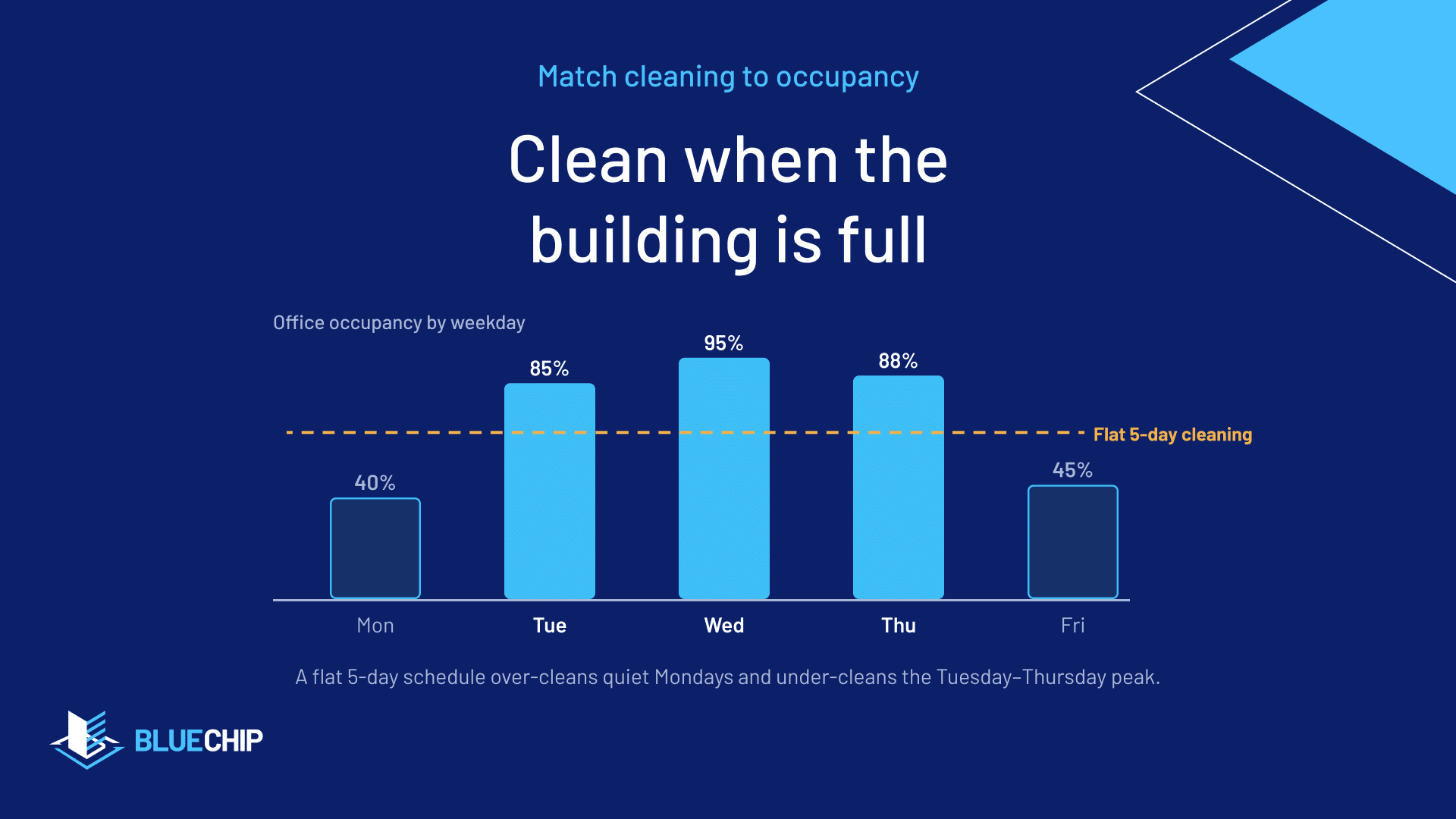
Most commercial janitorial services were made for a world where every desk was used from nine to five. Monday through Friday. Today, NYC office occupancy centers on intense three to four day peaks, usually Tuesday through Thursday. Applying a flat cleaning schedule to this uneven occupancy wastes labor on slow days. It also provides too little sanitation during peak surges. Transitioning to a data driven model prioritizes actual building usage. Adopting institutional-grade cleaning standards ensures objective quality control regardless of headcounts.
Recent occupancy trends in Class A Manhattan towers show that mid week spikes often double the germ load on high touch surfaces. If a team performs the same tasks on a quiet Friday as they do on a packed Tuesday, the facility is not actually clean. It is merely maintaining a visual clean that masks underlying risks. High frequency cleaning must be concentrated when occupants are actually in the building. To cut commercial cleaning costs, focus on the total cost of ownership rather than just monthly line items.
Implementing zone based cleaning allows labor to rotate based on departmental schedules. This ensures that busy areas receive the focus they need during peak times. Common inefficiencies in NYC contracts include full-floor vacuuming on low-occupancy Mondays. They also include daily trash pickup at empty workstations. At the same time, teams may neglect busy elevator banks during peak midweek periods. A specialized fitness center cleaning service may be needed for buildings with onsite amenities. It helps maintain hygiene during peak periods.
High frequency cleaning involves executing technical cycles that preserve a building’s long term value. Following APPA standards ensures every surface is maintained to prevent wear. This requires moving beyond daily trash pickup. It also includes documented weekly and monthly steps. These steps cover areas often missed by low-cost contractors. See a large-scale facility cleaning checklist.
Weekly cycles should include high dusting of HVAC vents, ducts, and air diffusers. Neglecting these areas leads to poor indoor air quality and causes visible soot to build up on ceiling tiles. By following a structured office cleaning checklist, facility managers ensure these technical tasks are not ignored.
Monthly tasks focus on asset protection. These include deep cleaning window sills and specialized VCT floor maintenance like strip-and-wax or sealer/finish programs. This frequency prevents the buildup of grout haze and floor finish oxidation. A modern office cleaning framework should detail these daily, weekly, and monthly requirements for floor care and HVAC maintenance. Protecting these assets now is significantly cheaper than a full facility restoration later.
| Task type | Standard frequency | High-frequency NYC cycle |
|---|---|---|
| High-touch disinfection | Daily | 3x Daily |
| HVAC vent dusting | Quarterly | Weekly |
| Restroom deep scrub | Monthly | Weekly |
| Floor buffing | Bi-Annually | Monthly |
In high security Manhattan environments, the labor model is a critical factor in quality control. Many companies rely on subcontracted labor to increase profits, which introduces security risks and lowers accountability. A consistent, W-2 workforce is the only way to maintain the standards required for premier NYC office space. When auditing your facility, ensure that your janitorial services are performed by employees who are fully vetted and trained. Choosing a reputable cleaning service for a business ensures that these security protocols are strictly followed.
Subcontracting often leads to high turnover and a lack of site-specific knowledge. In a multi tenant tower, you need porters who understand the specific security rules and logistics of your building. A W-2 porter becomes an extension of your facility team. They provide a reliable presence that subcontractors cannot match. This model is a core pillar of a value-based vendor selection framework that reduces total operational risk.
Daily W-2 porters are the first line of defense in busy lobbies. They reduce germs on elevator buttons and turnstiles in real time. Implementing this level of on-site facility support is critical. It helps build a high-frequency touchpoint disinfection program. This program protects occupant health throughout the workday.
High frequency cleaning is an investment in facility longevity. Blue Chip Building Maintenance has spent decades refining a W-2 labor model for the NYC metro area. We prioritize technical precision and labor accountability. By matching our service schedule to how you actually use the space, we help protect your assets. We also help you maintain high health standards.
Reliable, daily office cleaning services are essential for the security of premier NYC offices. Our process is rooted in APPA standards and a commitment to transparency. If you are ready to go beyond a clean look and start a strict maintenance program, it is time to review your provider. Schedule a walk-through with our team today to audit your facility’s current cleaning frequency.
95 %
© 2026 Blue Chip Building Maintenance | Privacy
This site is protected by reCAPTCHA and the Google Privacy Policy and Terms of Service apply.