
In the NYC real estate market, a single security breach can cost more than a decade of maintenance. The lobby matters, but who has the keys to it matters more. For facility managers at Manhattan corporate headquarters or NYC universities, the janitorial services model you choose matters. It is not just about cleaning. It is a risk management strategy. Low-bid models often hide the origins of their labor. This creates invisible security gaps that leave your building vulnerable.
Benjamin Franklin once noted that “distrust and caution are the parents of security.” In high-security environments, this caution must extend to every individual entering your facility after hours. When you skip vetting for janitorial staff, you may hire workers you have not verified. These workers can then have full access to your building. They may reach your most sensitive assets. In New York City, regulatory complexity meets high-turnover subcontracting. The standard for security must be significantly higher than a generic checklist.
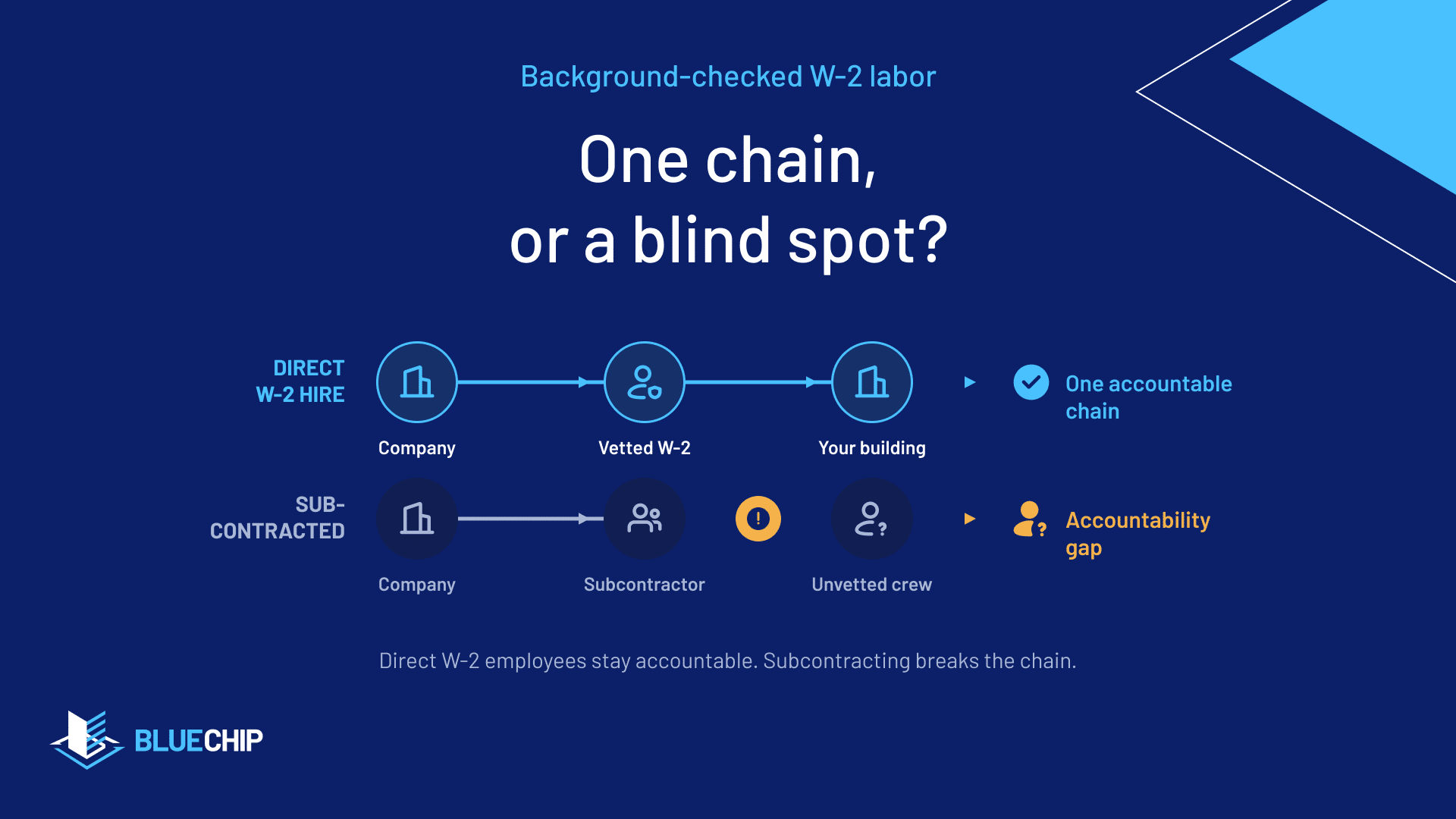
Many national sales desks and franchise operations rely on 1099 crews or tiered subcontracting to fulfill contracts. This creates a massive accountability gap for the facility manager. Before signing a contract, it is vital to understand the risks of franchising your business. Third parties may not follow your security standards. When a cleaning company cannot confirm a worker’s job status. It also cannot confirm the worker’s background check history. This creates a security risk. This is particularly true in the financial and healthcare sectors. Subcontracted labor often lacks the direct oversight required to ensure that security protocols are followed every single night.
Subcontracting fragments the chain of command. If a theft occurs or a door is left unsecured, the primary contractor often points to the subcontractor. The subcontractor may then point to a third party. This friction makes it nearly impossible to pin down responsibility. We believe that a direct-hire staffing model is the only way to maintain a clear audit trail. With W-2 employees, the company is directly liable for their actions. This forces a higher level of internal scrutiny and vetting.
John Darley and Bibb Lataníé measured this effect in 1968, and the result is counterintuitive enough to be worth stating plainly. In their experiment, when a subject believed they alone had heard an emergency, 85% reported it. When they believed four other people had also heard it, only 31% did. Their conclusion:
“…the presence of other bystanders reduced the individual’s feelings of personal responsibility.”
Darley and Latané – “Bystander Intervention in Emergencies,” 1968
Subcontracted models are notorious for high turnover, which acts as the primary enemy of facility security. Every time a new, unvetted individual enters your site, the risk of a protocol breach increases. Choosing labor based on availability, not careful screening, can become a costly hiring gamble. It may lead to management friction and security lapses. Consistent janitorial cleaning requires staff who know your specific alarms, keycard zones, and high-asset areas. A stable, vetted workforce reduces the need for frequent retraining and keeps security steady.
Rigorous vetting is a non-negotiable part of modern asset protection. Cleaning companies that fail to provide documented proof of background checks are increasingly being barred from NYC financial institutions. Property managers must verify if a cleaning company conducts background checks as a standard operating procedure. Rigorous vetting serves four primary functions:
NYC regulatory compliance requires a sophisticated, multi-stage vetting process. The Fair Chance Act mandates that criminal background checks for office cleaning services can only occur after a conditional offer of employment has been made. This law ensures applicants are judged on their qualifications first. It also requires employers to be diligent in their follow-through. For residential buildings, these standards are even higher. Co-op and condo boards expect strict security in common areas. Furthermore, specialized commercial janitorial services must adapt these protocols to meet the high-traffic demands of educational environments.
For facility managers, this means your vendor must have a robust HR infrastructure. They must manage these timelines without leaving your building understaffed. Many owners find that outsourcing janitorial services provides a necessary layer of liability transfer. A professional janitorial vendor framework understands these legal hurdles and maintains a pipeline of vetted talent. This compliance protects you from discrimination lawsuits and ensures that only qualified individuals are granted access.
Professional janitorial cleaning services in Manhattan should also include 24/7 security protocol training. This is especially vital for financial facility maintenance, where data leakage and unauthorized after-hours access represent catastrophic risks. When selecting cleaning companies for schools, the same standard of vetting applies to ensure student safety. Vetting is not a one-time event. It is a continuous process of auditing and accountability.
Security and cleanliness are not separate goals. They are two sides of the same operational coin. Accountable, background-checked W-2 labor is essential for the NYC metro area. Your building is a significant asset that requires both technical precision and rigorous security oversight. For over 30 years, Blue Chip Building Maintenance has served the NYC metro area. We use a direct employment process that closes accountability gaps common in subcontracting. Ensure your janitorial services meet NYC security standards. Audit your staff protocols and schedule a facility walk-through today.
Request your free quote today and discover how our professional maintenance team can elevate the standards of your facility.
95 %
© 2026 Blue Chip Building Maintenance | Privacy
This site is protected by reCAPTCHA and the Google Privacy Policy and Terms of Service apply.