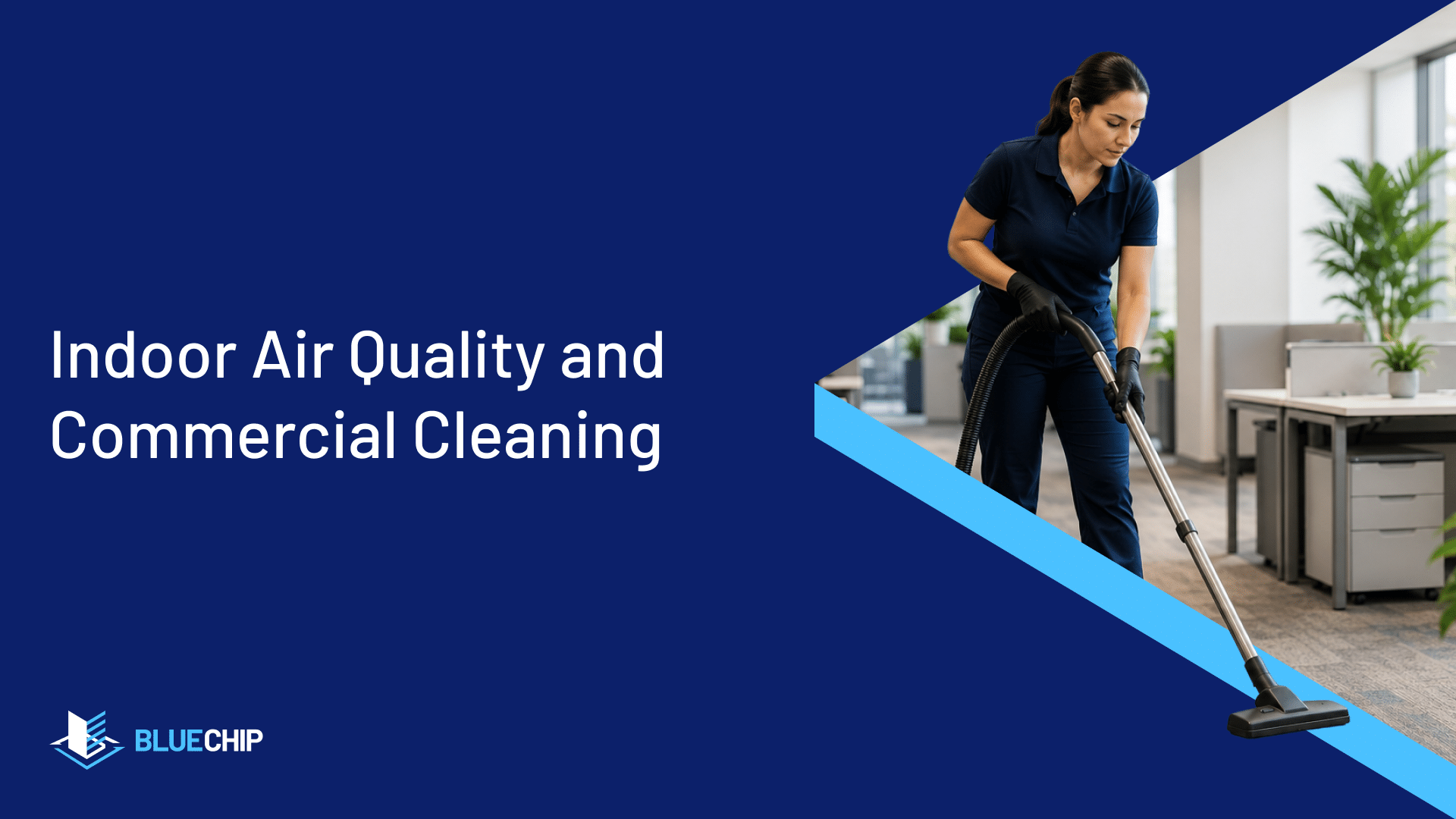
Smart building owners know that the air your tenants breathe is only as clean as the surfaces your janitorial crew maintains. In NYC’s high-density environment, managing indoor air quality is an engineering challenge. It starts on the floor. Traditional cleaning often moves dust instead of removing it. This can spread dust again and again. It may harm occupant health and affect LEED compliance. To keep the environment safe, we need to do more than make it look clean. Commercial cleaning should be treated as an important engineering control.
Surface management is key for air safety. Indoor pollutant levels are often 2 to 5 times higher than outdoor levels. This is according to the EPA. When dust and particulates settle on carpets or hard floors, they do not stay there forever. Foot traffic and HVAC cycles constantly kick these pollutants back into the breathing zone. A rigorous janitorial program focuses on capturing these contaminants at the source to prevent them from becoming airborne.
Dr. Joseph Allen, the Harvard School of Public Health researcher whose Healthy Buildings work has redefined how modern institutions think about the connection between indoor air and human performance, said it as clearly as anyone:
“The building you’re in is having a bigger impact on your health than you realize.” – Dr. Joseph Allen, Harvard T.H. Chan School of Public Health
Standard vacuums without HEPA filtration represent a significant risk to air quality nyc standards. These machines often trap large debris while exhausting fine particulate matter directly back into the office. This redistribution creates a false sense of cleanliness while actually increasing the concentration of respirable dust. High-performance programs must prioritize equipment that meets the highest filtration standards to protect sensitive medical and corporate environments.
OSHA identifies proper building maintenance and the control of moisture and dirt as essential. These steps prevent indoor air quality problems before they start. This involves more than just sweeping;it requires professional equipment that removes rather than redistributes pollutants.
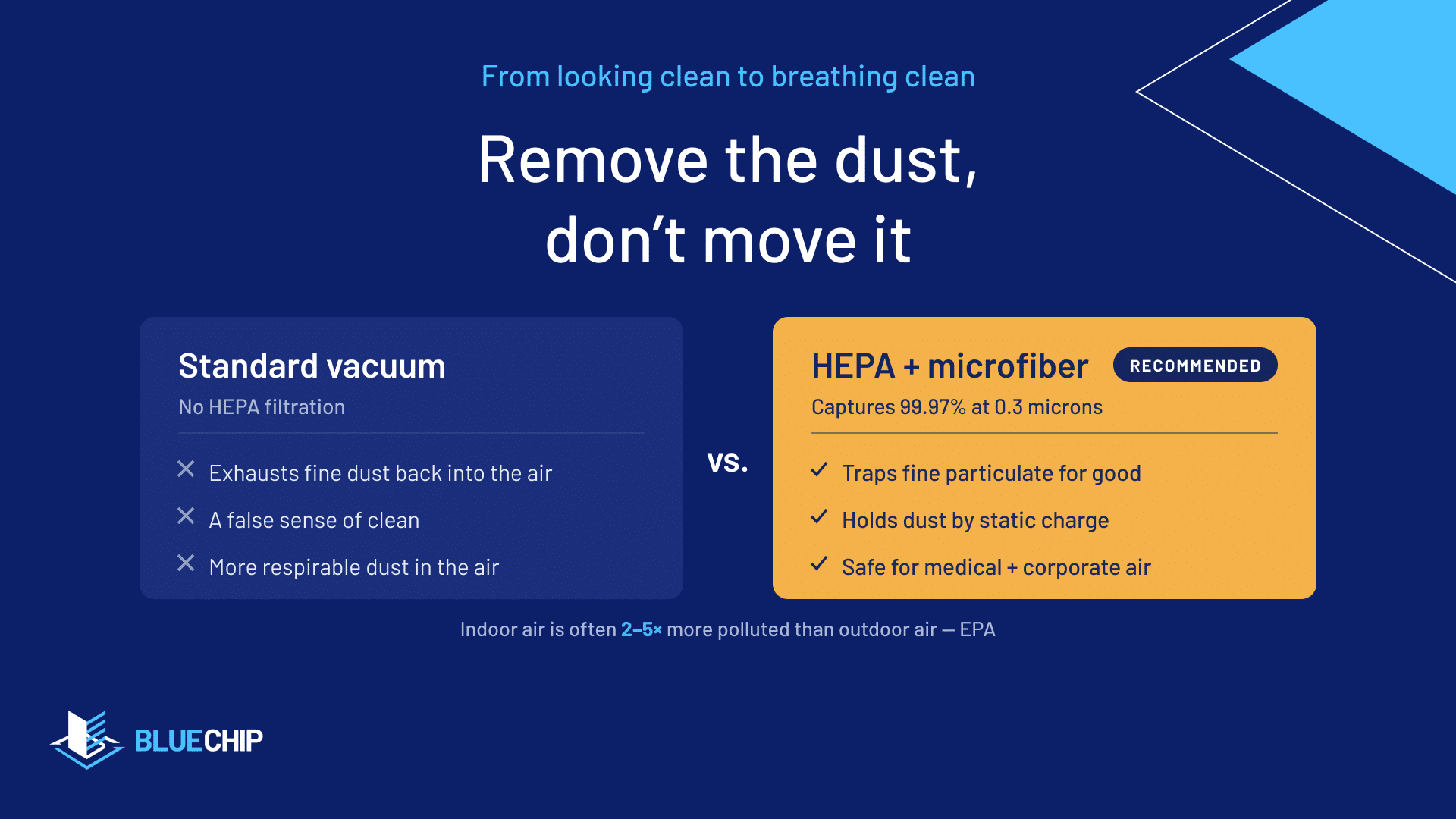
Blue Chip Building Maintenance employs a W-2 workforce trained in technical protocols that ensure actual removal of particulates. We use HEPA filtration systems and micro-fiber technologies that attract and hold dust through a static charge. These methods are common in places where air quality matters most. Facility directors use them when they manage WELL or LEED certifications today.
To ensure consistent results, we follow a technical hierarchy of cleaning. It focuses on removing organic matter before disinfection. This structured approach prevents the buildup of chemical residues that can contribute to poor air quality nyc metrics. Managing these details protects your facility assets and the people who use them.
Shifting from looking clean to breathing clean is a necessary evolution for modern NYC facilities. Protecting indoor air quality requires a partner that understands the mechanical and technical aspects of particulate management. Blue Chip Building Maintenance has provided these sophisticated services for over 25 years in the NYC metro area. We understand that professional janitorial care is a vital part of your overall maintenance strategy.
Rita Colwell, the microbiologist whose research on environmental health earned her the National Medal of Science, closed her career of institutional research with a line worth pinning to every 25-year facility partnership:
“You have to protect the environment as if your life depended on it – because it does.” – Rita Colwell, former Director of the National Science Foundation
Contact Blue Chip Building Maintenance today to schedule a walk-through.
%
© 2026 Blue Chip Building Maintenance | Privacy
This site is protected by reCAPTCHA and the Google Privacy Policy and Terms of Service apply.